 En
En

One MCP for 1,000+ apps —fully under your brand
A unified, white-label MCP for your AI agents.
- No MCP firefighting and maintenance. Ship your product instead
- Secure, multi-tenant authentication, right out of the box
- Your agents execute across 1K+ apps. Your users stay locked into your product
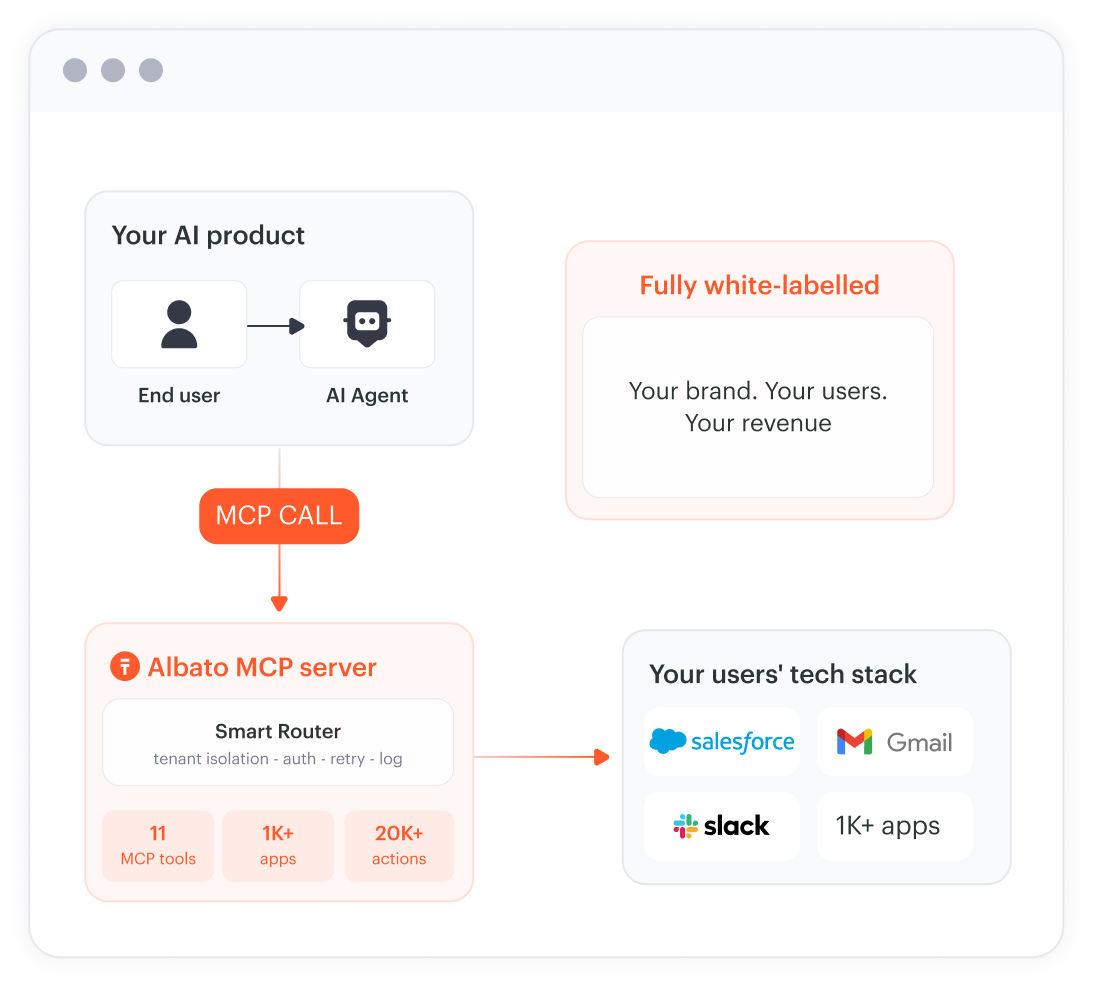
Ready for your business & engineering needs

Your AI agents drive more value. Users stick with your product.
Albato MCP lets your users execute actions across 1K+ apps inside your agents. Better UX, higher retention.

One "set-and-forget" MCP for all apps and endpoints.
We handle MCP maintenance, API updates, schema changes, and auth flows. No more brittle MCPs.
1,000+ apps inside your AI agents. No extra subscriptions.
A fully connected execution layer across CRMs, marketing tools, and more. Without third-party costs.
Tenant isolation. Full visibility. Auto-retries and alerts.
Encrypted OAuth tokens. Every action logged. SOC 2 Type 2, GDPR, AES-256.
Integration infrastructure you plug into your product so your AI agents can execute actions in third-party apps on behalf of your end users. Each user's credentials are isolated. Your end users never see the infrastructure provider.
Albato MCP Server is a white-label, multi-tenant embedded MCP server built on top of Albato's integration platform (1B+ monthly API calls, 300M+ monthly tasks). Your AI agent calls our single MCP. Albato routes each LLM request to the right app and API endpoint under the hood.
More MCPs = worse AI agents for your users
Every external MCP you add bloats your agent's context — and that's your customer's problem
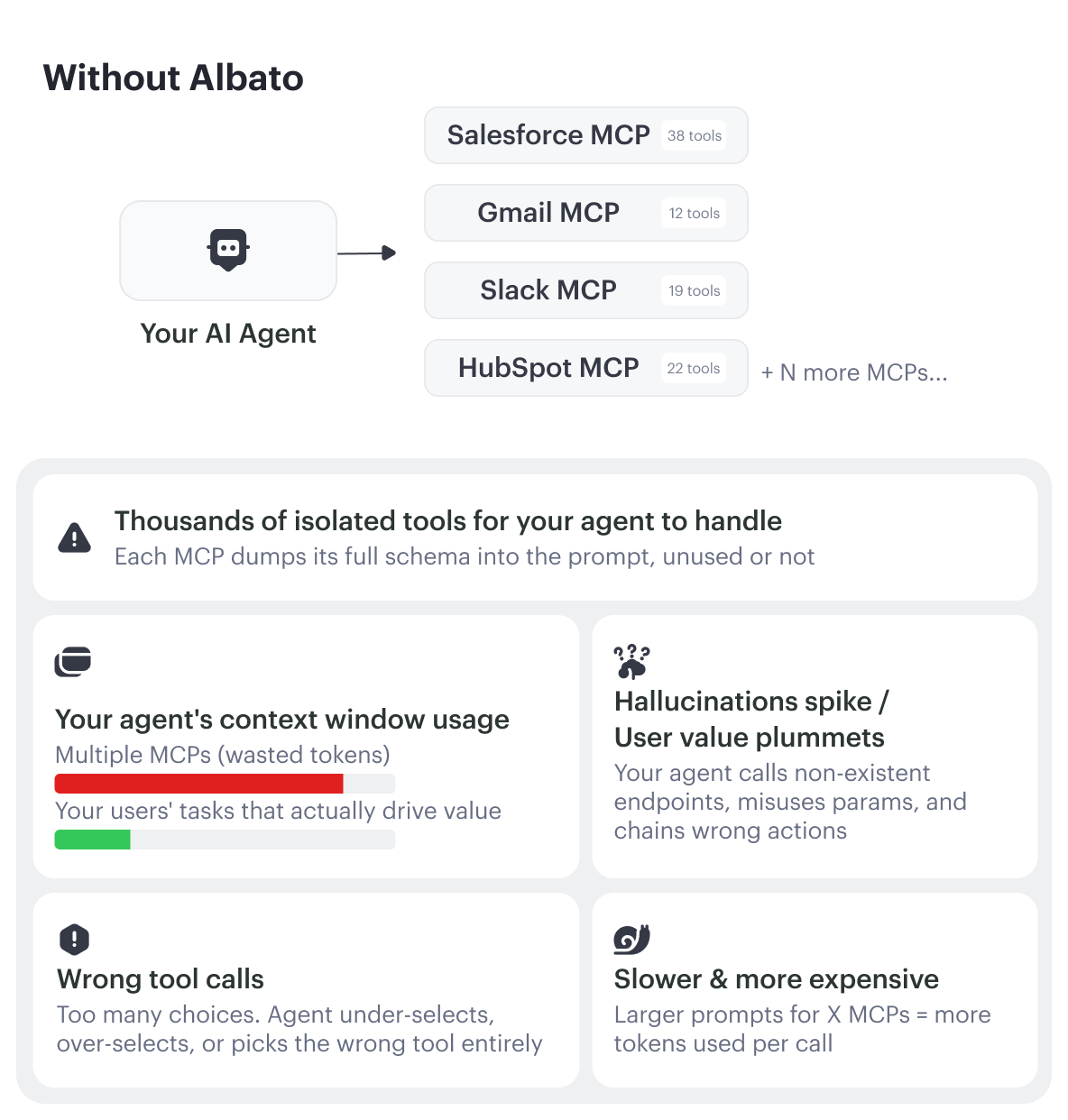
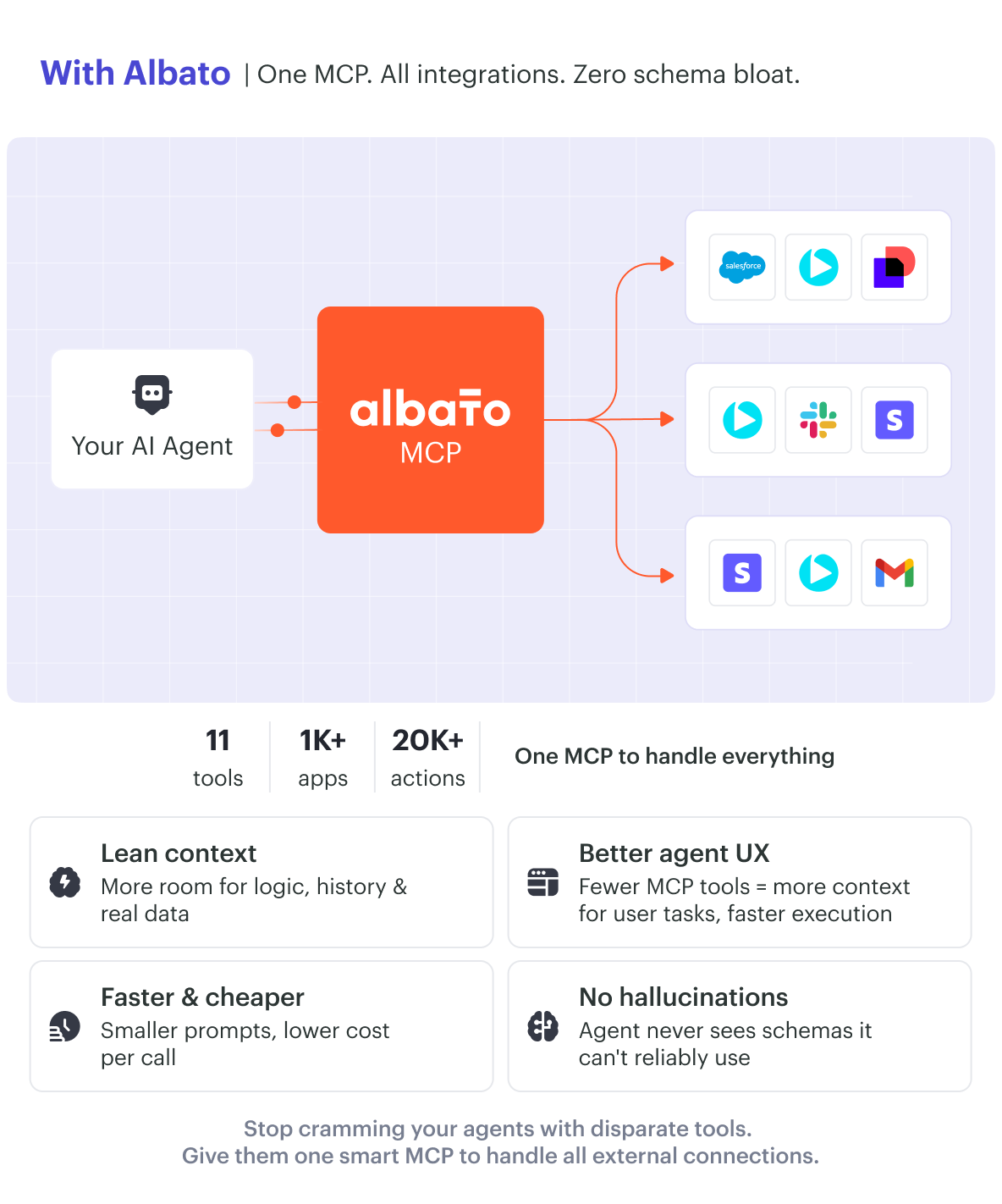
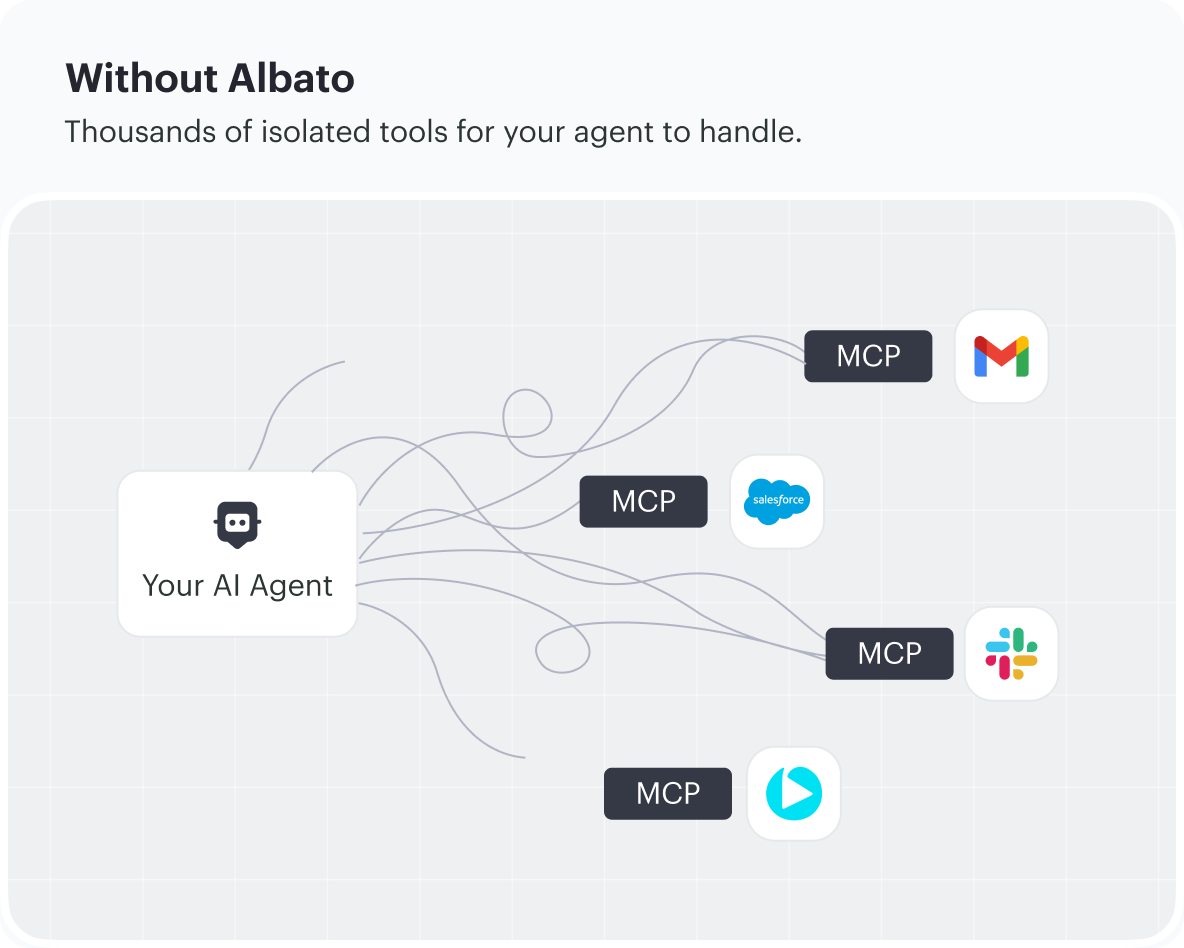
Your AI agent can integrate with any app. But every MCP connection takes a toll
Every new MCP = new server & infra, new error types, new tool calls, new auth logic. That's time spent on plumbing, not your product.
 one app = one mcp
  Without Albato
 Each SaaS app has its own MCP, auth, rate limits, and error codes. 10 apps = 10 separate MCP integrations on your roadmap.
 With Albato
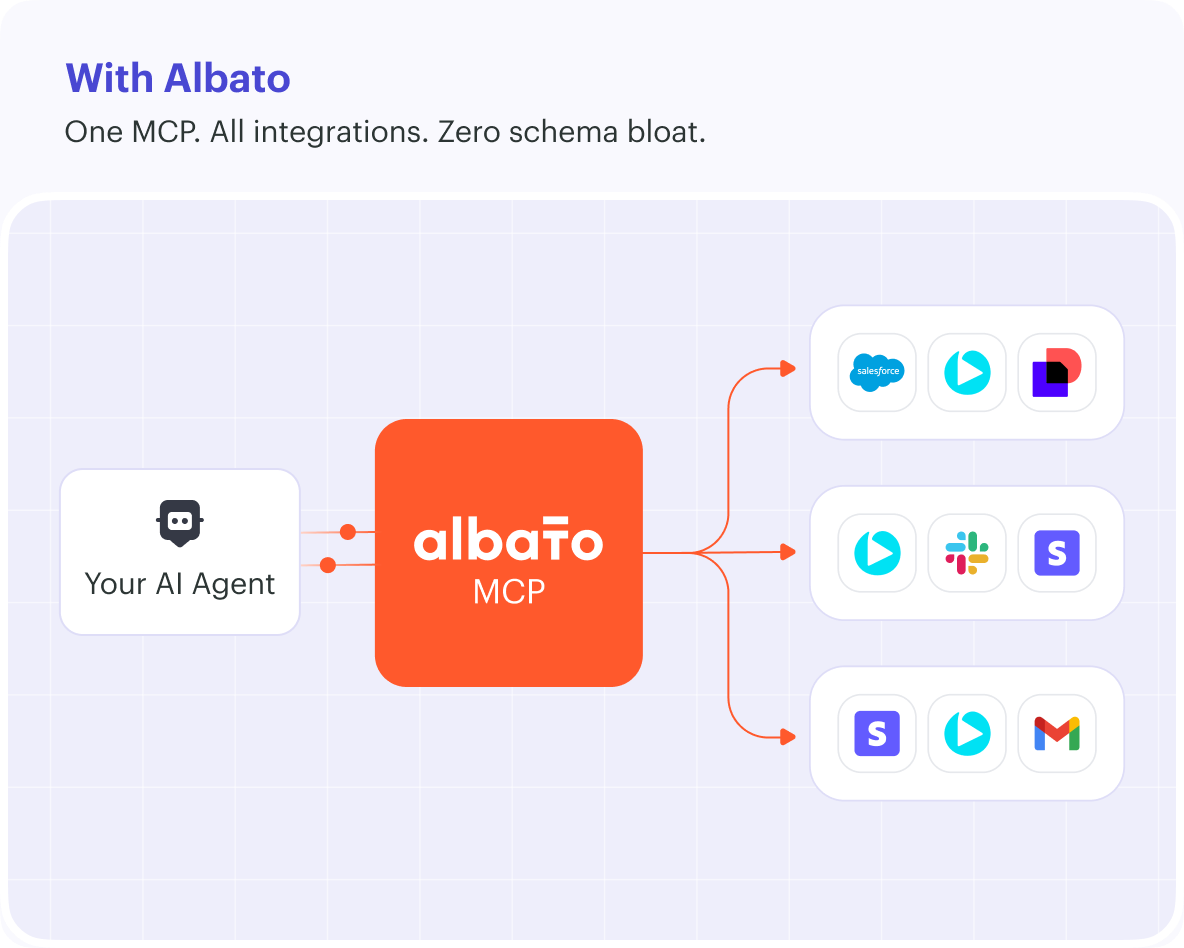
 One MCP endpoint. 1,000+ apps. No separate configs.
 Credentials at scale Without Albato
 Managing auth tokens, refresh cycles, and credentials for every user across every app. Unscalable.
With Albato Purpose-built for B2B multi-tenant use. Create and manage users via API, each with isolated credentials.
 Maintenance never stops Without Albato
 APIs change without notice. MCPs break. Error handling is inconsistent. Every connection = one more to maintain.
With Albato Third-party API changed? Albato updates the connector and the universal MCP. Your team doesn't touch it.
 Blind spots everywhere Without Albato
 No visibility into what your agents are doing across apps. Failures are silent until a customer complains.
With Albato Full observability. Logs, usage stats, MCP status, and errors in one dashboard.
 Third-party brand, third-party revenue Without Albato
 External branding, separate logins, sometimes separate billing. Parts of the UX move outside your product.
With Albato White-labeled OAuth. Users see your brand. Climbo grew revenue 70% doing exactly this.
 50 apps = 50 MCPs Without Albato
 Every integration adds another MCP server. Complexity compounds fast.
With Albato One MCP endpoint, one auth flow, one dashboard, one support team. 1,000+ apps.
What your product can do with Albato MCP
Three ways SaaS companies use Albato MCP to deliver integrated AI experiences to their customers.

AI copilot in your product
User asks your copilot: "Update the lead in Salesforce." Your agent calls Albato MCP with the tenant ID. Albato authenticates, executes, and returns the result. The user never leaves your product.

Multi-step workflows your agent can't build alone
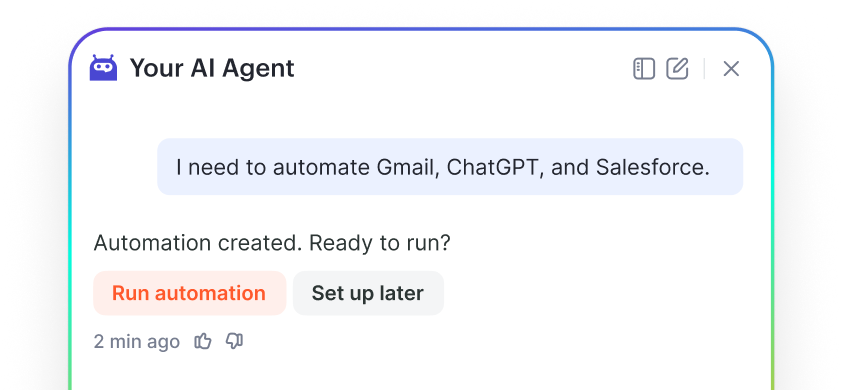
Your agent can make a single action call, trigger a prebuilt workflow template, or set up a recurring scenario on a schedule. One MCP call creates a contact. Another triggers a full chain: enrich → CRM → email → Slack → follow-up. Albato orchestrates the entire flow; your agent just triggers it.

Data enrichment from your users' tools
Your agent pulls contacts from HubSpot, deals from Pipedrive, and activity logs from project tools. All through MCP, all with per-user isolation. Richer context, no tab-switching for your user.
How it works
MCP is the LLM-facing middleman. Albato's integration engine is what runs it.
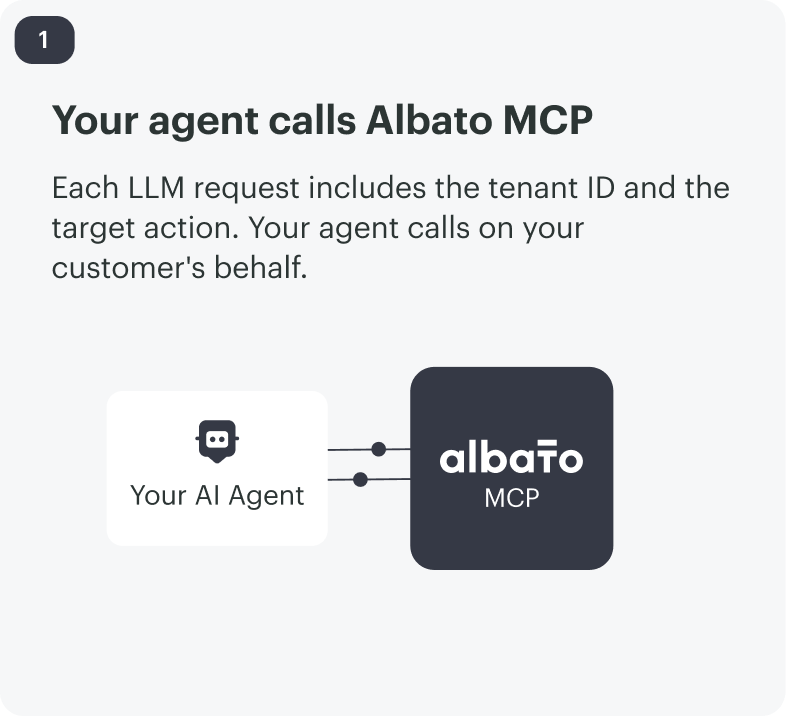
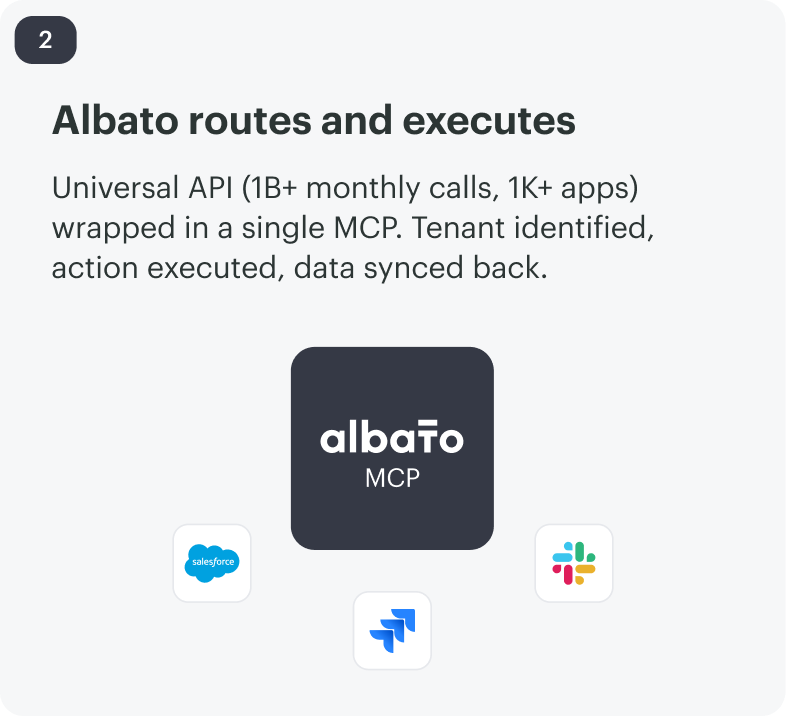
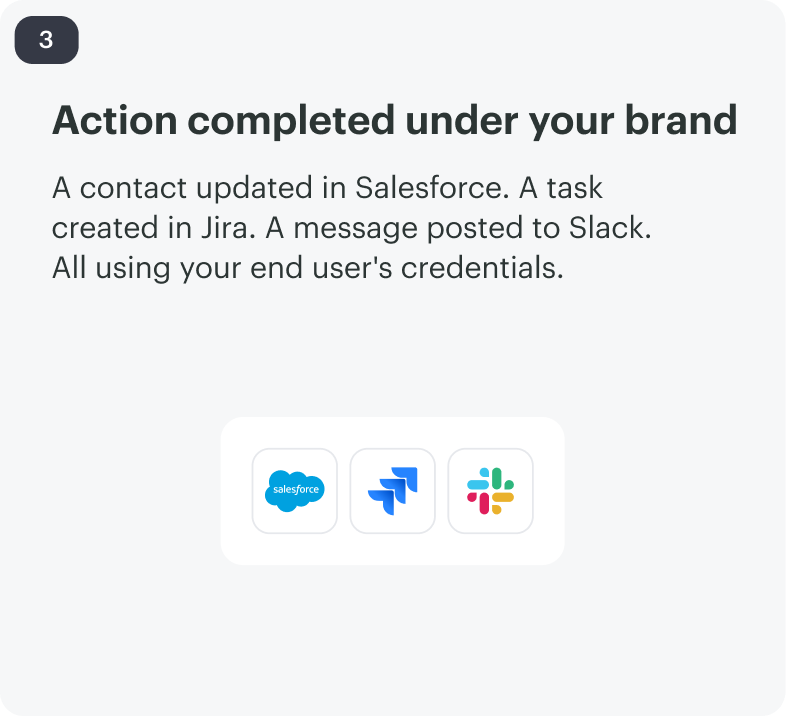
How users connect their apps:
White-label auth flow embedded directly in your agent. User clicks "Connect," authenticates once with their own credentials, and every future agent action runs under their account — isolated from all other tenants.
Proven reliability at enterprise scale
Security and Reliability

SOC2 Type 2 certified
Annual independent audits. Full report available under NDA.

GDPR Compliant
Albato does not analyze, store, or use data flowing through connectors. 60-day log retention with GDPR opt-out.

AES-256 at rest, TLS 1.2/1.3 in transit
All credentials stored encrypted, decryption keys on a separate secure server.

Per-user credential isolation
Each end user's OAuth tokens stored independently. Never accessible to another user or tenant.

AWS multi-zone infrastructure
2 availability zones. VPN-only hosting access. Authorized personnel only.

Code security & pen testing
OWASP standards, SAST in dev lifecycle. Regular third-party penetration testing.
SaaS teams running on Albato's infrastructure






Albato helped us build it in 1-2 months, with almost zero engagement from our R&D.
What it costs to do this without Albato
| Native MCP servers | Albato MCP | Build in-house | |
|---|---|---|---|
| Setup | |||
| Time to go live | Fast per server, but multiply by app count | Days | 4-7 months |
| Estimated cost | Free per server, but ops overhead grows | Platform fee | ~$150,000 (engineering time) |
| Infrastructure | |||
| App coverage | One server per provider | 1,000+ apps, one endpoint | Only what you build |
| Per-user isolation | Varies. Most for single-user | Included | Build it |
| Auth management | Per provider, per user | Included. White-label connect flow | Build it |
| Monitoring | Separate dashboard per provider | One dashboard, all apps and users | Build it |
| Ongoing maintenance | Each provider independently | Albato, all connectors | Your team, per connector |
| Business | |||
| Branding | Users see third-party brand | Your brand | Your brand |
| Monetization | Revenue goes to MCP provider | Yours | Yours |
| Support | Each provider separately | Dedicated PM, CSM, API engineer. Under 30 min response | Your team |
Questions from engineering teams
No. Same platform, same connectors, same infrastructure. Albato Embedded offers MCP alongside iFrame and Headless API models. They share the same backend, billing, and connectors. You can start with iFrame for end-user self-service integrations and add MCP for AI agent functionality without migration.
For simple, single-action calls (send an email, create a task), native MCP servers work fine. Albato is built for a different scenario: when you want integrations as a feature of your product. That means white-label (your users don't see a third-party brand), multi-tenant (per-user credentials at scale), monetization (you decide which integrations go in which plan), multi-step workflows, unified monitoring, and one support team instead of dozens. If your product just needs to google something and send a message, you probably don't need Albato.
Yes. The server is multi-tenant. Each request includes tenant context, and Albato routes to the correct user credentials and permissions.
You embed a white-label connect flow in your product. Your end user clicks "Connect," authenticates with the third-party app (HubSpot, Salesforce, etc.), and Albato handles the OAuth exchange, token storage, and refresh cycles. You can also manage connections programmatically via the Embedded API.
Yes. Deployment options include:
Hosted by Albato (standard)
Self-hosted on your infrastructure (enterprise)
Restricted to specific IP ranges or auth tokens
SOC 2 Type 2 (annual audits), GDPR compliant, AES-256 encryption at rest, TLS 1.2/1.3 in transit. Regular third-party penetration testing.
Albato is a white-label embedded integration platform with three integration models in one: iFrame (visual builder for end users), Headless API (custom UI), and MCP (for AI agents). Most competitors offer one model or separate products for each. Albato runs all three on the same infrastructure, with the same connectors and billing. Plus: 1,000+ managed connectors, dedicated PM and API engineer on all plans, and response times under 30 minutes.
No. OAuth flows, connect pages, and the entire integration experience can be fully white-labeled. Your users interact with your brand only.
Albato uses a task-based model. Your agent submits a request, Albato processes it, and returns a result. Your agent can check status anytime without maintaining conversation state.
Albato provides a full Embedded API: create/delete users, assign billing plans, manage transaction limits, create SSO connections, and receive webhook notifications for connection status changes. All via REST endpoints.
Albato. All connector maintenance is handled by our team. When an API updates, we push the fix.